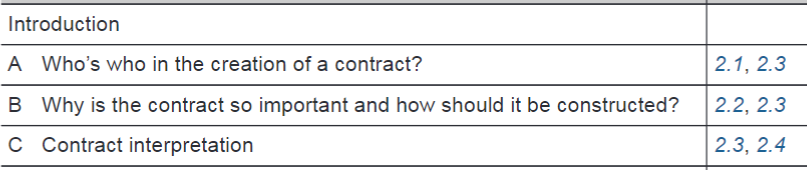
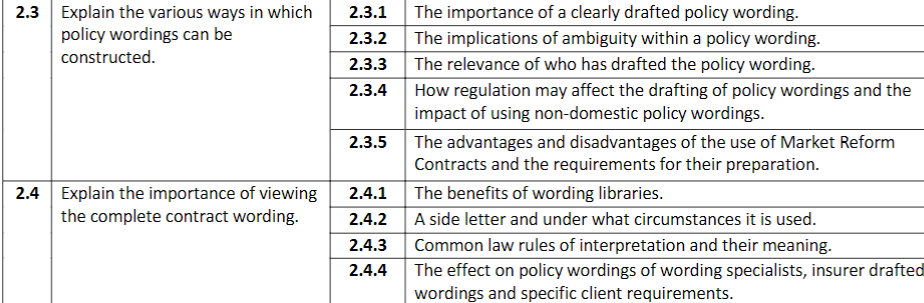
C2 - Policy Wording

SETS OUT T&Cs
How are they evidenced?
What difficulties might you face if there is a dispute some time after the agreement was supposedly made?
State make motor, employers’ liability, professional indemnity for certain professions such as solicitors, and public liability COMPULSORY
Flexibility VS Ambiguity:
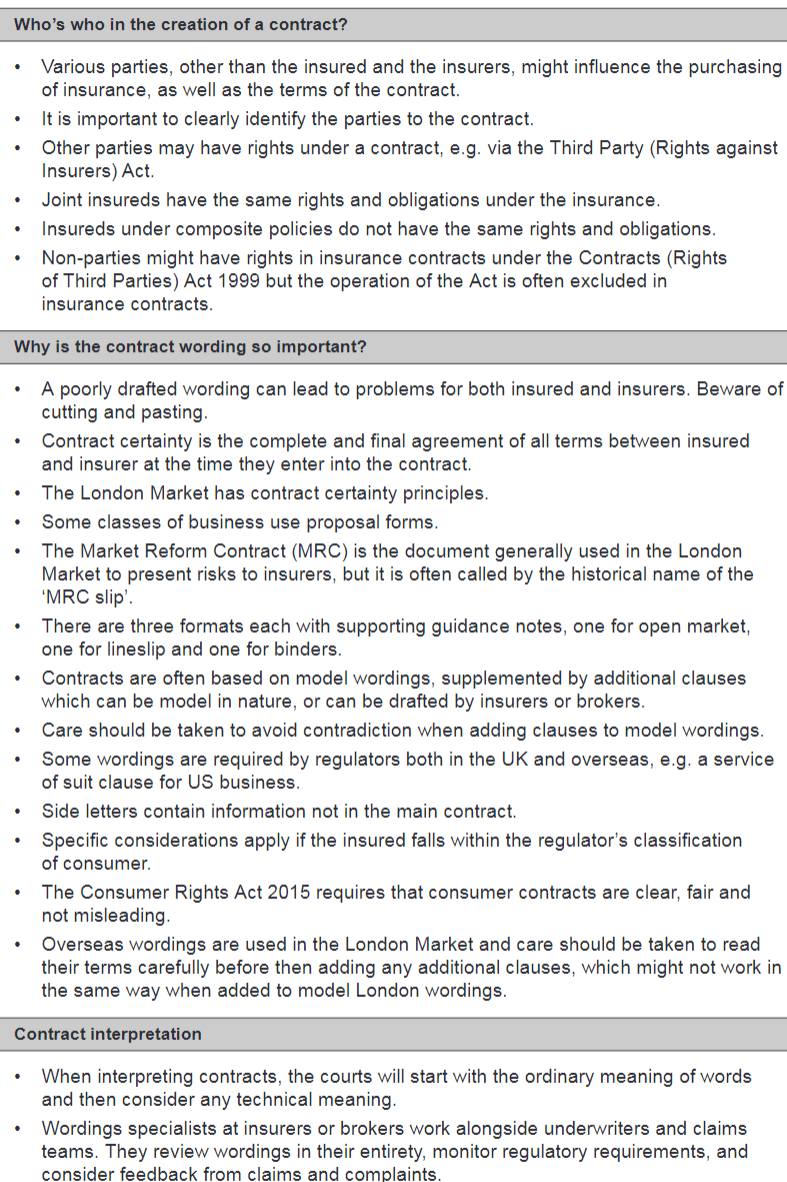
Who are the parties of the contract
main insured + additional parties
JOINT = two or more parties are insured and their interests are the same
COMPOSITE: a landlord and tenant not the same interest
A coverholder/MGA is the third party to which underwriting authority can be delegated under a binding authority
Who has right and obligation
joint policies is indivisible so if one of the insureds breach any terms WILL lead to insurers have right to invoke LEGAL remedies
IF composite then 1 entity innocent is exempt
Contract law
- Privity... who can make a claim/see insurance contract
- Third party Act 2010 - The Act lets an injured person claim directly from the insurer when the person or company responsible for the loss is insolvent
- Contract Acy 1999 -
Importance of contract and its structure
Policy limit
each and every loss?
Aggregate?
Sublimits?
Excess - Full stated policy limits SITS above it
Deductible - Deducted from stated policy limit
Cost in addition - NOT erode policy limit
Cost inclusive - (Exposure exess layer insurers or shouldered by insured) think legal cost
Policy period - include time zone and 24 hour format
Conditions - What are Renewable energy market standard clauses?
- Perils covered
- Excluded
- terms with Power of warranties
- Terms with precedent to liability
- Is Cyber crime covered?
Price - Currency value vs SOV value
LM2 - C8 - Business process#8.C) Key terms and conditions used in policy wording
LM2 - C8 - Business process#8.7 Changes to contract after agreed, approval via GUA & Endt
Contract Certainty
LM2 - C8 - Business process#8E) Contract Certainty
Steps:
- Entering into the contract
- All terms are clear + unambiguous by time offer is made
- Within TERMS... Conditions OR Subjectivities expressed
- After entering into the contract
- Final Docs shared
- Demonstrating of performance
1. - Contract changes
- Certain and documented promptly
OR
More than 1 participating insurer:
- Certain and documented promptly
- Contract contains: Agreed basis on which each insurer's final participation determined
- AVOID over placing
MRC
- Open Market
- Lineslip
- Binding authority
LM2 - C8 - Business process#8.5 Purpose + Content of OPEN MRC (Market reforms contract)
Blue print 2... MRC v3...
Value of wording libraries
broker, insurers or clients create wordings
Committees create new/update wordings (insurance act 2015 or enterpise act 2016)
Deleting exclusions will widen coverage (Look for extreme coverage examples)
Impact of broker-drafted contracts on same topic
Contracts includes other Clauses
2 separate elements of text could contradict each other.
Clients like broad Terms & Conditions + More added = increase chance of contradicition/conflict and ambiguity.
broker clauses act differently eg ROD
Regulators require specific wordings
For consumers
general requirement in the USA for a service of suit clause to be inserted into contracts
Side letters and when used
Side letters are used in matters deemed sensitive, where one party does not want information shared with wider parties which might have access to contractual documentation.
There are other uses for side letters such as:
• Clarification – side letters are often used to confirm additional details that are not known when the main documents are finalised, or to clarify certain points.
• Variation – when dealing with any last minute changes, it is often easier to set out the relevant details in a side letter than to make manuscript changes and have them initialled.
Side letters are also an efficient means of documenting any changes that have been agreed in relation to a party’s standard terms and conditions
Reverse Engineering for Wording
Used in reinsurance market -
Fronting and admitted bases
Consideration when clients are consumers
Consumer Insurance (Disclosure and Representations) Act 2012
Insurance Act 2015
Clear and unambiguous insurance policy
micro-enterprise should be treated more like consumers than commercial customers
consumer and micro-enterprise), as well as small businesses with up to 50 employees or turnovers of less than £6.5m
can use the Financial Ombudsman Service (FOS) LM2 - C10 - Claims handling#10E) Complaints Handling AND Services provided by FOS & FSCS
clear; • fair; and • not misleading.
Impact of using wording outside the london market
Lead by non-London market OR client wants wider wording
If CHANGES are made to a model wording IS uncertainty or ambiguity created
Overseas wording: check has an inbuilt dispute resolution contract e.g. a law and jurisdiction clause or an arbitration clause).
Careful using an US-based insurer wording in other countries to dispute resolution
For example LM2 - C8 - Business process#Type of Conditions precedents are + remedies for breach
are not legally recognised in some jurisdictions
c. The wording might have a different interpretation under English law.
Contract Interpretation (Good as its Papers Worth)
Courts interpretation of Documents (MRC slip and Policy wording)
so if a term is deemed unfair under the provisions of the Consumer Rights Act 2015 it will be interpreted in their favour.
Common law rules of interpretation
Ordinary meaning -
technical or legal meaning -
Inconsistencies from model wording adaption were what the party intended
policy wording trumps SLIP
Interpretation issues with client contract
If the client drafted the contract (or inserted bespoke wording into it), then the client becomes the drafter — so any ambiguity in that wording would now be interpreted in the insurer's favour instead.
Role of wording specialist
Persons responsibility to check contracts fit together properly, are clear, fair, non-misleading, cohesive and above all make sense.
- considering them in their entirety for ambiguity/ contradictions
- development of new products/contracts considers Regulations and statutory requirements both home and overseas
- issues which arise from claims and complaints, and assisting underwriters and placing brokers with possible solutions
- monitoring changes in law
Wider business risk