LM3 - C2 - Policy Wording
LO C2 - Policy Wording


(Good as its Papers Worth)
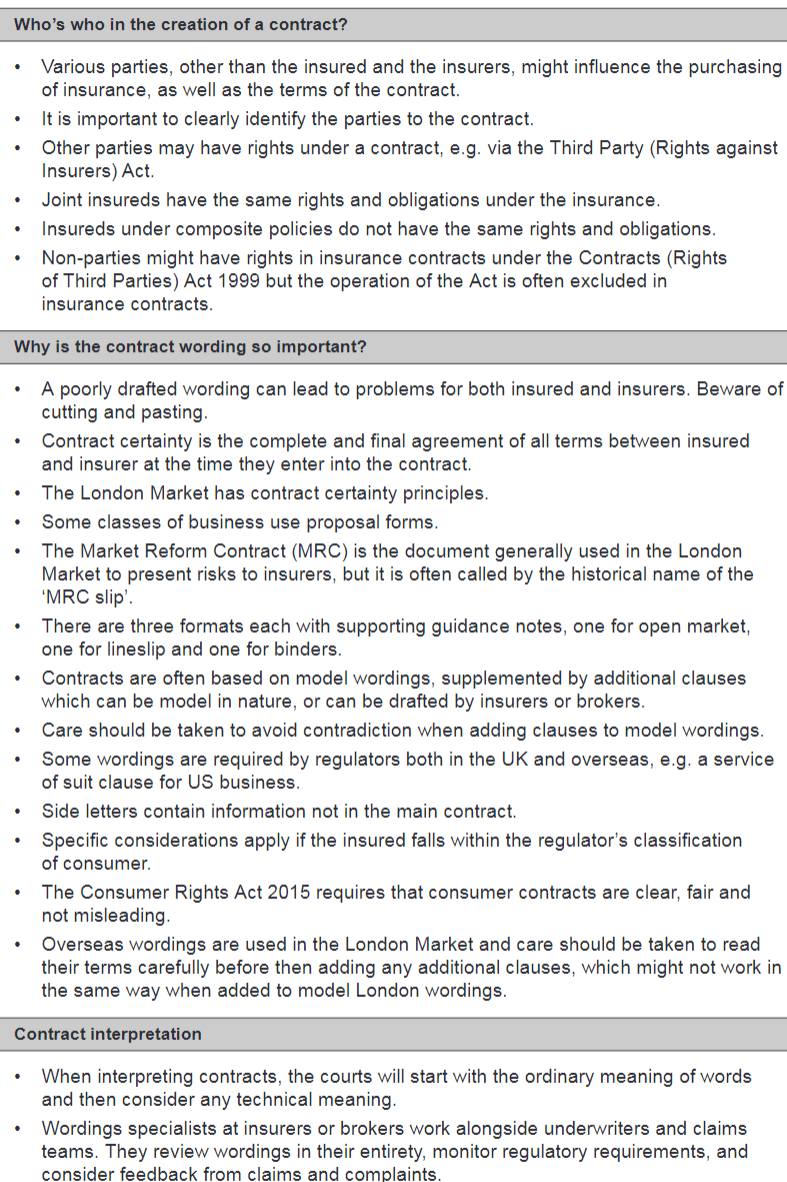
2.1 Importance of knowing identity of the contracting parties
2.1.1 Knowing the Identity of Contracting Parties
- State/Government compulsory types e.g. Motor, 3rd party liability, employers liability
- Companies transacting with new partners = PI insurance
- Bank lending money (Banks sent out terms)
- Broker providing professional advise (advises clients of insurance options)
- Risk manager
- Other insurers
SETS OUT T&Cs
- How are they evidenced?
- What difficulties might you face if there is a dispute some time after the agreement was supposedly made?
- BUSINESS PARTNERs need confirmation of insurance cover before starting work.
COMPULSORY Insurance TYPES
- State make motor, Road Traffic Act 1988
- Employers’ Liability,
- Professional Indemnity for certain professions such as solicitors, and public liability (Riding School)
Clients can be active or passive in creation of insurance contract
- Insured Insurance knowledge
- Delegation to broker
- If they have inhouse risk management/legal function involved in the process
Flexibility VS Ambiguity:
Brokers job is obtaining an insurance agreement that meets the client’s requirements and is as wide and flexible as possible.
2.1.2 Who are the parties to the contract of Insurance
Insured - Subject Matter
Main Insured + Additional Parties (EDF Oman + panel manufactures)
- JOINT = Two or more parties are insured and their interests are the same (e.g. co-owner of a property)
- COMPOSITE = A landlord and tenant not the same interest
IF composite then 1 entity innocent is exempt.
Different Interests in the subject matter! Or separate portions for each insured
Insurers
A Coverholder/MGA is the third party to which underwriting authority can be delegated under a binding authority
Who has right and obligation under the contract ?
-
Joint policies is indivisible so if one of the insureds breach any terms WILL lead to insurers have right to invoke LEGAL remedies
- Deliberate and reckless breach of the duty of fair presentation, it could lead to the contract being avoided.
-
Regulation tells you whether you can transact with them at all or face severe penalties
2.1.3 How other parties obtain access to insurance policies
Contract law
- Privity...
- Normally, only the parties to the contract have rights and obligations under it.
- A third party does not automatically have the right to enforce the insurance contract.
- Third party (Rights against Insurers) Act 2010
- The Act lets an injured person claim directly from the insurer when the person or company responsible for the loss is insolvent
- Contract (Rights of Third Parties) Act 1999 - Rights to outsiders to enforce a contractual term.
- A third party can enforce a contract if the contract expressly says they can OR Clearly identified.
- Insurance contracts can specifically exclude the operation of the Act.
2.2 Importance of Policy Wording
2.2.1 Contract Certainty (CCCP) and its implication if not achieved
Contract Certainty Code of Practice (last edition September 2018)
What is desired end result,
Which is an agreement that meets the client’s needs and is clear and unambiguous.
Complete and final agreement of all terms between insured and insurer when the contract is entered into; and contract documentation being supplied promptly afterwards.
Contract certain - Final agreement of all policy terms by both parties, prior to the inception date.
PRINCIPLES A - F:
A. Entering into the contract
1. All terms are clear + Unambiguous by time offer is made
2. Within TERMS... Conditions OR Subjectivities expressed (which are a type of terms)
B. ==After entering into the contract==
3. Final Docs shared
C. Demonstrating of performance
4. Proof of steps 1 and 2 above
D. Contract changes
5. Must be certain and documented promptly
OR
More than 1 participating insurer:
E. Contract contains:
1. Agreed basis on which each insurer's final participation determined
F. After entering into the contract:
2. Final participation must be provided to each insurer promptly
G. Where the contract has not met the principles:
3. Resolve exceptions to any of the above principles
Post-inception over-placement should be avoided.
...
Consequences include:
- Disputed claims, delayed settlement, litigation/arbitration, additional costs, financial uncertainty, reputational damage.
The WTC example
More Info LM2 Contract Certainty
2.2.2 Specific requirements for consumer insurance policies
Definition of a consumer was someone who buys insurance other than for their trade, business or profession,
- Consumer Insurance (Disclosure and Representations) Act 2012
- Insurance Act 2015 - Power to the consumer if there is a breach of warranty
- Consumer Rights Act 2015 - clear; • fair; and • not misleading. Clear and unambiguous insurance policy
micro-enterprise treated AS Consumers VS commercial customers
DEFINED as small businesses with up to 50 employees or turnovers of less than £6.5m
can use the Financial Ombudsman Service (FOS)
or
fewer than ten people and has an annual turnover of less than €2m
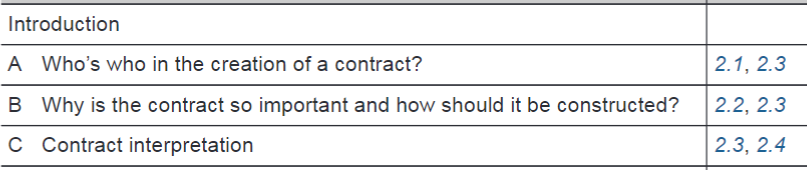
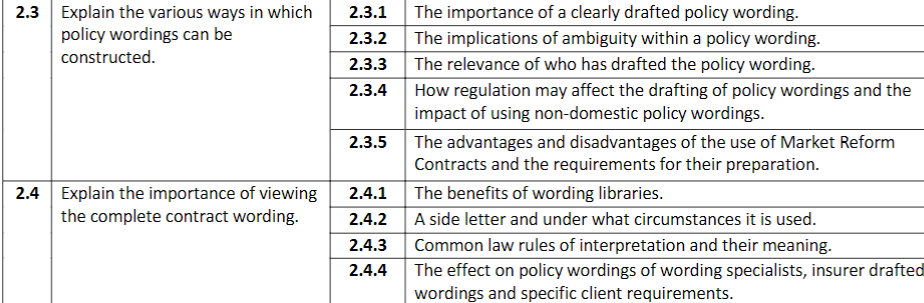
2.3 How can Policy wording be constructed
2.3.1 Clearly drafted policy wording
Consensus Ad Idem or ‘meeting of minds’ = parties are in complete agreement.
Both parties must be in complete agreement.
EXAMPLES BELOW OF Provisions of an insurance contract & What can go wrong
Insured: Is entity a sanction? checks and additional insureds
Insurers: Buying Reinsurance? is rating poor?
Subject Matter Insured: Correct vessel?
Location of risk: Check if correct?
Regulatory breaches: Correct PERMISSIONS to write risk in a location!
Policy limit structure:
- Each and Every Loss?
- Aggregate?
- Sublimits?
Excess or Deductible
- Full stated policy limits SITs above it
- Deducted from stated policy limit
Cost in addition - NOT erode policy limit
Cost inclusive - (Exposure excess layer insurers or shouldered by insured) think legal cost
Policy period - Include time zone and 24 hour format
Conditions - What are Renewable energy market standard clauses
- Perils covered: All, EQ, Fire, SCS, Flood, Wind,
- Excluded
- Terms with Power of Warranties (Insurance warranty)
- Terms with Precedent to Liability (Insurers obligation to pay is conditional upon "terms" requirement)
- Is Cyber Crime covered?
Price - Currency value vs SOV value
Post-bind decision makers & Dispute resolution provisions
More info on Key terms and conditions used in policy wording
Key idea: Changes after agreement require the appropriate approval process.
Implication of ambiguity within a policy wording
2.3.2/3 Implication of ambiguity and who within policy wording
contra proferentum rule, which means that ambiguities will be interpreted or construed against the drafter
Impact of broker-drafted contracts on same topic
Contracts includes other Clauses
2 separate elements of text could contradict each other.
Clients like broad Terms & Conditions + More added = increase chance of contradiction/conflict and ambiguity.
Broker clauses act differently e.g. ROD in addition or within sublimit
2.3.4 Regulation may affect the drafting of policy wording + Impact of using wording outside the London Market
Regulators
- Require specific wording For consumers
- General requirement in the USA for a service of suit clause to be inserted into contracts.
- For example conditions precedent to liability are not legally recognised in some jurisdictions
- The wording might have a different interpretation under English law.
- Permissions often come obligations... reporting and the payment of taxes
France/Israel - forms, cover notes, contracts must be in French/Hebrew.
- Exception for large risk country whose law governs the contract
Lead by non-London market OR client wants wider wording
If CHANGES are made to a model wording IS uncertainty or ambiguity created https://crystalplus.lloyds.com/home
Overseas wording:
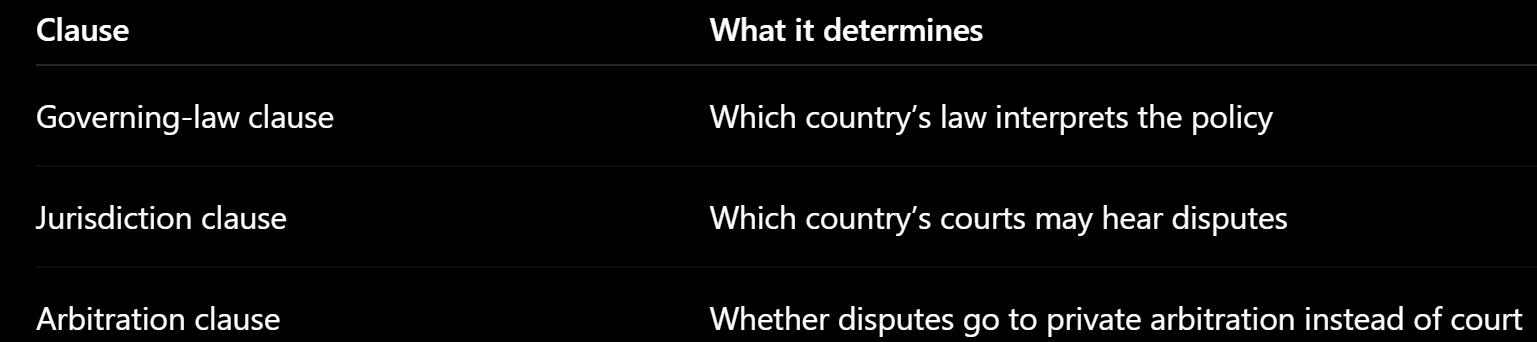
Check has an inbuilt dispute resolution contract e.g. a law and jurisdiction clause or an arbitration clause).
- Careful using an US-based insurer wording in other countries to dispute resolution
Reverse Engineering for Wording
Used mainly in Reinsurance/Fronting arrangements where the reinsurer ultimately wants to carry the risk.
- Local regulations require an admitted/local insurer to issue the policy.
Insured → Local/Fronting Insurer → Reinsurer
or
Company -> Admitted insurer -> Captive
Key Risk – Wording Mismatch
Direct policy broader than reinsurance → Fronting insurer may have an underinsured exposure.
Why might wordings differ?
- Drafting errors / clauses missed.
- Local regulation requires clauses or cover in the direct policy that aren't in the reinsurance.
Difference in Conditions
Can be used within global programmes where local policies provide narrower cover than the wider global/master programme.
Main concern: Avoid gaps between the direct policy and reinsurance protection.
2.3.5 Advantages and disadvantages of MRC and requirements for their preparation
MRC - About history and purpose of document!
- Open Market
- Lineslip
- Binding authority
Blue print 2... MRC v3...
Advantages:
- Mandatory headings, guidance supports correct completion;
- Flexibility exists for class-specific needs; data appears in the same place regardless of broker/class;
Disadvantage - If the MRC is issued directly to the client, it may not be the easiest document for an “outsider” to the market to read
2.4 Importance of Complete Contract Wording
Courts interpretation of Documents (MRC slip and Policy wording)
so if a term is deemed unfair under the provisions of the Consumer Rights Act 2015 it will be interpreted in their favour.
2.4.1 Benefits of Wording libraries
Broker, insurers or clients can create wordings starting from a blank page = Manuscript/Bespoke Contract. (prevails - treat as formal policy)
Committees create new/update wordings (insurance act 2015 or enterprise act 2016)
Deleting exclusions will widen coverage (Look for extreme coverage examples)
Brokers can reference ‘library code’ which might, for example, start LSW/CL, LMA or similar.
EVERYONE NEEDS to KNOW model clauses
If as the broker or insurer you want to amend a model clause, you can either do so using tracked changes or list the amendments by clause or section number.
2.4.2 Side letters and Purpose
A side letter is a separate contractual agreement that sits alongside the main MRC/slip to vary a contract. Consensus and consideration
Common Uses
- Clarification – Confirms details not fully known when the MRC was finalised.
- Variation – Records last-minute agreed amendments without altering the signed MRC. Documents agreed departures from a party's standard T&Cs.
- Confidential Matters – Keeps commercially sensitive agreements between Specific Parties.
Example
MRC: Engineering survey required within 90 days of inception.
Side Letter: Confirms the agreed surveyor, timing, information requirements and/or allocation of survey costs.
Key Risk Of Side Letters
Having contractual terms spread across the MRC + side letters can create contract certainty issues, particularly:
- Which document takes priority? Are follow insurers bound?
- Does the side letter conflict with the MRC?
- Did the leader have authority under the GUA to agree the matter for followers?
Follow Market Perspective
A leader signing a side letter does not necessarily mean followers are bound by it. Check the parties, wording and GUA authority.
Key question: Why is this in a side letter rather than the MRC?
Side letters are less concerning when used for clarification, confidentiality or bilateral administrative matters.
Greater caution is needed where they materially alter coverage, deductibles, premium or policy obligations.
2.4.3 Common law rules of interpretation and their meanings
Courts use "ejusdem generis" which means ‘of the same kind’, Is the unlisted peril of the same kind as those listed?
think drug smugglers wanting ship to reach destination. Is that malicious? Exclusion for consequences? Proximate Cause?
Ordinary meaning - Courts normally assume words were intended to have their ordinary meaning.
Technical or legal meaning - A recognised technical or legal meaning may be used where appropriate. (Average, normal, underinsurance, loss)
Broker drafts MRC/slip as insured’s agent.
- MRC states:
- Documents required
- Who produces them
- Any insurer approval requirements.
- Insurers are treated as having agreed the wording.
- Ambiguity → interpreted in insured’s favour.
- Added/specific clause → overrides conflicting standard wording.
- Policy Wording → overrides conflicting MRC/slip.
The court looks at who drafted the wording. Once this is established the benefit of the doubt will be given to the other party!
Interpretation issues with client contract
If the client drafted the contract (or inserted bespoke wording into it), then the client becomes the drafter so any ambiguity in that wording would now be interpreted in the insurer's favour instead.
2.4.4 Role of wording specialist
Persons responsibility to check contracts fit together properly, are clear, fair, non-misleading, cohesive and above all make sense.
-
Considering CONTRACTS in their entirety for ambiguity/ contradictions
-
Development of new products/contracts considers Regulations and statutory requirements both home and overseas
-
Issues which arise from CLAIMS and COMPLAINTS, and assisting underwriters and placing brokers with possible solutions.
-
Monitoring changes in law
Wider business risk
Principle of Solvency II instructs insurers to consider other types of business risk such:
- Operational
- Counterparty Risk
(Go back to Basics Do parties understand what they are getting into).
Contract will be found to be deficient, exposing the insurer to financial and reputational risks?
Principle 1: Underwriting profitability
High-level Principle: managing agents should produce and execute syndicate business plans that are logical, realistic and achievable, and ensure the delivery of a sustainable profit, including expense management.
Sub-Principle 3: have underwriting controls, monitoring and reporting in place that are appropriate to their risk profile in order to deliver the agreed business plan. The practical guidance under this sub-Principle includes:
- pre- and post-bind reviews to be done; and
- use of specialist legal/wordings personnel to assist with the production of wordings.
Ensuring that Contract Certainty is achieved.
Key points