LM3 - C5 - Distribution
LO
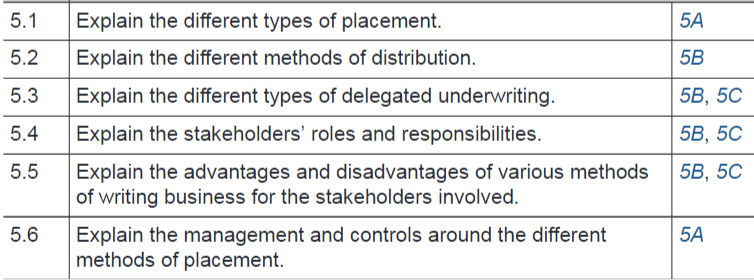
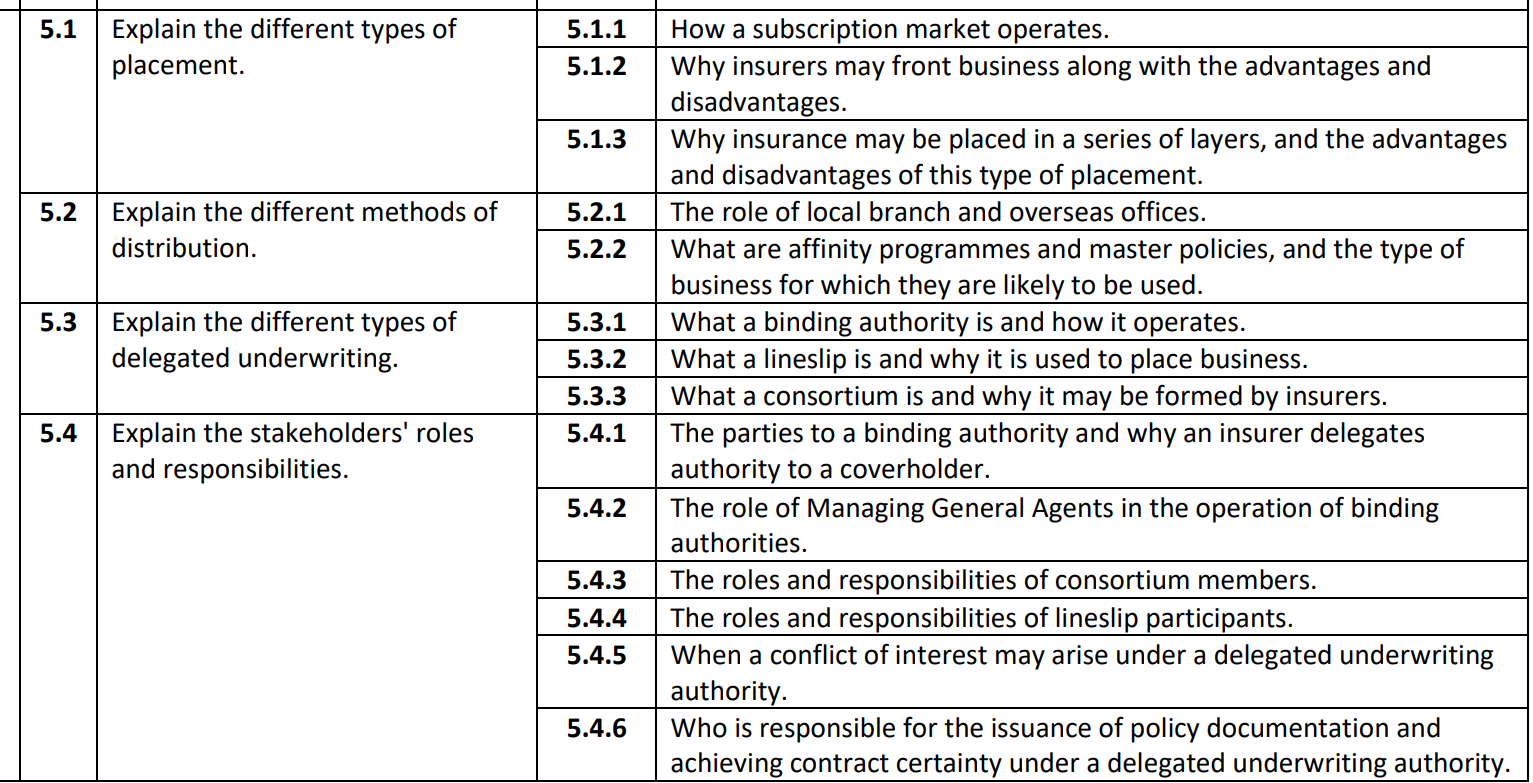
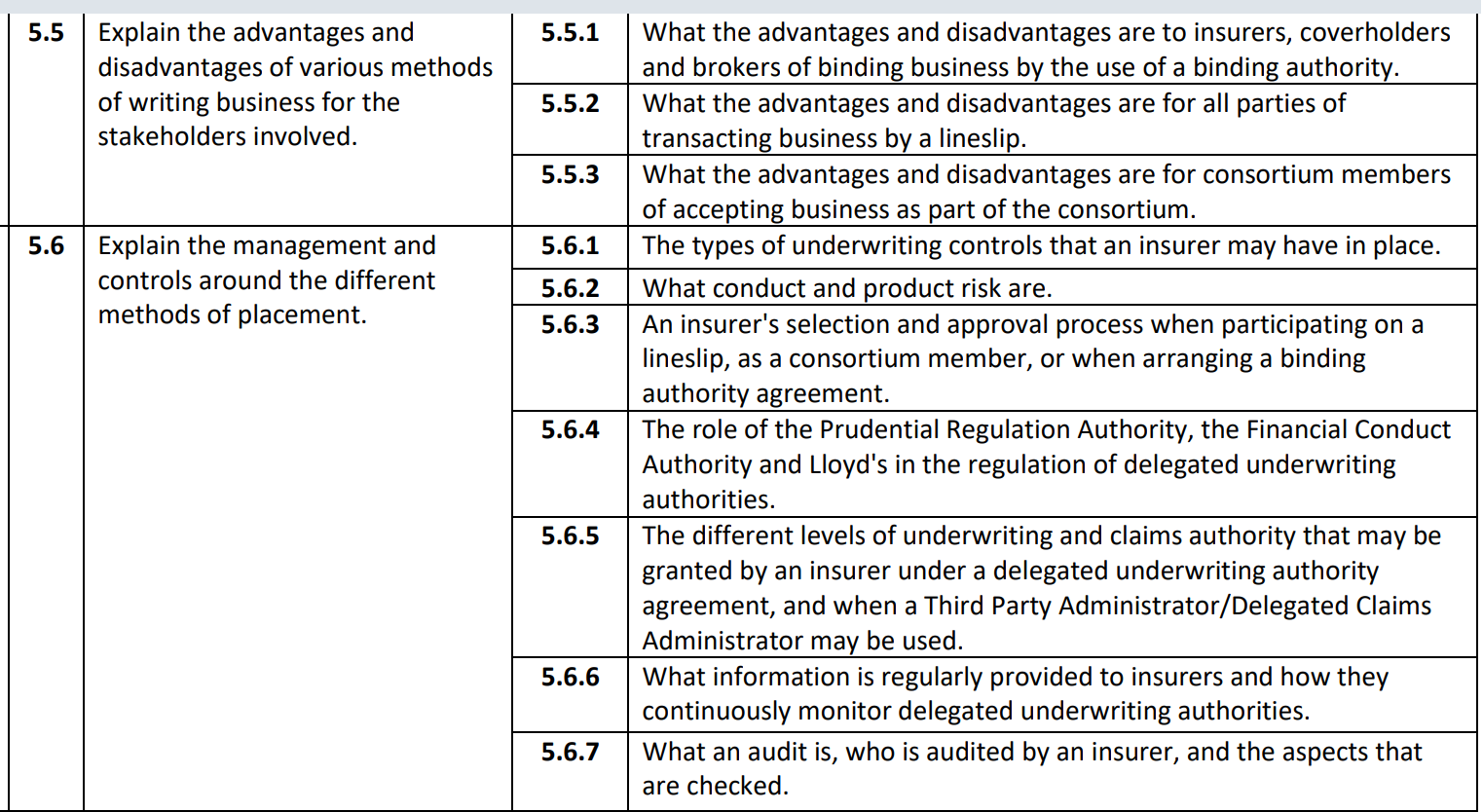
5.1 Different Placement Methods
5.1.1 Subscription market
Underwriters have control over right column but not left column!
| Enforced choice | Real choice |
|---|---|
| Broker influence | Managing capacity |
| Licensing | Branch office controls from head office |
| Client influence | Managing aggregates |
| Availability of reinsurance | Managing geographical exposures |
| Price | Price |
| Insurers must build relationships with Client + Broker to maintain business |
- Price
- Speed
- Aggregations
Check for UNDERWRITING RESITRICTION (Region, risk code, sub block, capacity)
Insurer can choose to take 100% of a risk or a smaller share
Restrictions - To prevent the insurer from accidentally writing the same risk from different offices.
5.1.2 Concept of Fronting is reinsurance
Insured - Reinsurer creates gap for insurer
Company -> Admitted insurer -> Captive
Or
Brazil Risks
Advantages
- Access business not otherwise available
- Reinsurers - Control drafting of the contract
- Reinsurers - Implement claims control Others Full follow, Co-operation
Disadvantages
- Original insures ignore wording & settle claims WITHOUT reinsures involvement
- Commissions
- Litigation overseas would be costly and risky (credit risk)
primarily liable to pay claims to the insured
Direct and reinsurance is a better portfolio mix - Linked to Business Plan
What is the source of risks and platform/structure?
What are the distribution methods?
- Only Open Market basis or Delegated underwriting?
- How to manage/mitigate Exposure
- REMEMBER Fac RI Consider each risk on its own merits closest to direct!
- Proportional treaty (QS/SL) = Require Risk Bordereaux
5.1.3 Layers and appetite
When will insurers respond in a tower and Retention from insured
- Are legal cost within sum insured?
- Will erode the limit layer & upper layers exposed more rapidly.
- Legal cost in addition to policy limit with no financial cap... LOWER level will face with a larger defence cost burden HAS to STATE IF SHARED with upper layers. (Layers should have similar terms of cover OR could not be recoverable)
5.2 Distribution methods
5.2.1 Local and overseas branches
Lloyds Australia (marketing), Brazil (marketing), Dubai (Service Company), Singapore (Similar to Dubia), China (), Japan (Coverholder writing non-life business for syndicate), USA, Brussels (subsidiary).
Brokers also have offices aboard
Location between insurer, retail and wholesale broker
- Lloyds moat allowing brokers to place business via market place and
USA for direct business permission of Admitted status or only as a surplus lines carrier.
5.2.2 Group/affinity or Master programmes
Group/affinity
Group of customers associated with a bank OFFERS insurance products. (Monthly fee bank provides benefits)
Group/affinity programmes (travel insurance, phone, car breakdown, phone)
Be aware of:
- What are the exclusions? Travel insurance over 70s exl!
- Conduct risk? Underwriting controls in a consumer product
Master policies
1 policyholder (bank or employer) cover provided to members of that group. Company buying private health care for employees or liability cover for professionals
2. Coverage is provided to members of group
5.3 Different types of delegated underwriting authority
Partnering with other insurers/3rd party:
Delegated authority to another insurer under a Lineslip/Consortium or to a third party under a binder, (control is being lost)
5.3.1 What is Binding Authority (Binder) and how it operates
- Binding Authority is the agreement the Coverholder or service company receives the authority.
- The Coverholder can create the contract, but the contract is not with the coverholder.
- Parties define the authority in writing
- Delegate underwriting attracts low value, high volume risks. Presented via BINDERS
Next... Determine Level of control over risk selection
- Full authority
- Predetermined rates with discretion
- Predetermined rates with discretion
- Prior-submit authority
5.3.2 Lineslip - GORF or Marsh facility
- Broker (Like to place large volumes) so organise groups of insurers.
- Lead insurers bind follow markets.
- Followers can get bound to risk outside there authority and need to be diligent (Check)
5.3.3 Consortium - Ark Renewable energy book
- Leader responsible for reporting bound risks
- Broker place large amounts of security and leaders see business
- Business seen Consortium partners and construction extension
ARK E3, R2/R4 (9575) + R1/R3 (9574)
5.4 and 5.5 Stakeholders Roles/Responsibility & Advantages/ Disadvantages of delegated underwriting authority
Consortium members and lineslip participants Role and Responsibility
The insured and the insurer only.
Brokers role
The duties of the agents towards their principals are to:
- obey the principal’s instructions; act in good faith
- exercise proper care and skill; perform duties personally;
In return the agent is - to be paid or indemnified
Conflict of interest arises when
- Intermediary between Insurer and MGA
- Coverholder holding authority on behalf of insurer.
Broker-coverholder = two principals; pure MGA = insurer principal only.
If a broker is a coverholder, who is its main client? THE INSURED.
Post bind authorised changes GUA!
This agreement sets out the terms on which insurers can bind their co-subscribers to changes to the risk
Using partners to attract business
- MGA (Volt) have 1 principle which is insurers
- Broker can be Coverholder but 2 principles = conflict
- MGU (Managing General Underwriter (PERse)) sit between MGA and insurers.
Insured → broker → MGA/MGU → insurer or Lloyd’s syndicate
Parties to a Binding Authority - The insured and the insurer only.
Risk vs benefits for an Insurers of partnering with another organisation
- Cost effective grouping of small risks, New Bizz, MGA knowledge/connections
- MGA - depends on location but OPEX lower on per risk basis even with commissions, localised claims handling, vs employing inhouse underwriting team.
Risk vs benefits for MGA
- High quality security, reputational benefits and fairly free to run book.
- BUT Insurer may by pass MGA
Broker Position Can
- Be the Coverholder hold authority on behalf of insurer
- OR connect Insurer and MGA
Broker holds authority: Pros
- High quality Security - for low value, high volume risks
- Overseas business
- Built relationships with MGA
Cons!!! - Dependent on 1 MGA
- Additional regulatory + compliance
- Authority = additional headcount (Responsibility) increase base cost
- Loss relationship with other insurers (How Secure is the process?)
Identify risks then steps to mitigate and manage them.
Acquisition costs - Advantages and disadvantages
More parties in chain = Higher acquisition cost
VS Open-market business = Lower?
Higher acquisition costs do not change the Pure Risk Premium, but they reduce the insurer’s retained premium and profit margin, potentially making marginal business unprofitable.
-
Lineslip Acquisition Cost: Broker placing business onto the Lineslip, maybe leader.
-
Consortium Acquisition Cost: Broker placing business into Consortium + Leaders fees and profit commissions
-
Binding Authority Acquisition Cost:
- Broker placing business
- Coverholder commissioning for placing business
- Getting business placed
- profit-based commission
Other cost: TAX, fire brigade
FCA want consumers to get fair price THUS track acquisition costs
Breach of their instruction or action not authorised
WHEN brokers consider markets for placing clients business shouldn't be swayed by additional income from a binder.
5.6 Underwriting Controls and Peer Review
5.6.1 Types of Underwriting Controls an Insurer may have
Individual authorities:
Expressed authorities which are documented. (i.e. Risk can only be bound to a certain value) + factual elements.
First level of Authority given to inexperienced underwriter:
- Agreement to non-material Endorsements
- Inking a line on a piece of business previously agreed by another underwriter
- Confirming acceptability via electronic systems
The assistant is completing and recording a decision already made.
Managing exposure vs Empowering people to make decisions
Lloyds principle 1, & sub principle 3:
Managing agents understand risk profiles in order to deliver the agreed business plan
Basis of promotion as gaining authority.
Operational risk if authority not followed
Individual risk control:
Underwriting peer review:
- Check if risk within appetite - Check for (historic exclusions removed?)
- Learning experience spotting trends or might need to buy Fac RI
- Go easier on underwriter when reviewing.
Higher level Control:
Principles of doing business: Robust governance and oversight in place from executive level to monitor delivery and outcomes in accordance with business plan.
Underwriting guidelines.
- Prevention controls: Written authorities, and robust policies and procedures.
- Detection controls: Such as audits, breach reporting and peer review processes.
FCA Principles for Businesses (PRIN)
PEIN 1 - profitability
2 - due skill, care, diligence
3 - risk management
4 - Claims
6 - interest of customer
8 - conflict of interest
10 - Governance
11- REGs + Financial crime
12 - good outcomes for retail customers
5.6.3 Insurer selection/approval process for Lineslip, Consortium, Bind Authority Agreement
Delegated underwriting and insurers business plan:
-
Binding authorities - In a binding authority, authority is delegated to a third party (a coverholder/MGA), who is NOT a party to the contract of insurance; the contract remains between the insured and the participating insurers.
-
Lineslips - Delegated to another insurer (the leader), who IS a party to the contract of insurance.
-
Consortia - Delegated by a group of insurers/syndicates to a consortium leader, who accepts risks on behalf of all participants. All participating insurers are parties to the insurance contract.
If insurer are not leader under above agreements better focus on the risk is required.
Partner selection
- VOLATILITY OF Delegated underwriting (mentions above)
- What is the Teams experience? Risk appetite
- Assessment of partners what metrics to consider
Partner approval
- Lineslip and consortia - Requires STRONG CONTRACT with explicit parameters, results history.
- Coverholder to be approved at Lloyd's + Robust operational systems, Underwriters bound by principles for lead and follow business
- Coverholder process (investigation) ARE
- business continuity plan – what to do if a disaster strikes the office;
ATLAS system: central storage and broker gathers information for Lloyds approval.
5.6.4 Role of PRA, FCA and Lloyd’s in regulating delegated underwriting
FCA and PRA
FCA and PRA + Lloyds partial regulators
Rules apply to businesses choosing to use delegated underwriting/outsourcing in business model.
PRA regulates an insurance company that enters into delegated authority
PRIN: due skill, care and DD, control + risk management, interests of customers
Check Section Higher control by managers
Lloyd's
Risk based approach to approval application for delegated underwriting. Including parties handling claims.
Flexible discretion will allow firms to be given delegated authority without having to obtain Lloyd’s prior approval
Intermediaries Byelaw:
A managing agent may only delegate authority to enter insurance contracts on behalf of its syndicate to:
- Its directors or employees
- Other individuals providing services, with Franchise Board consent.
- Another managing agent or authorised insurer under a line slip.
- Another managing agent under a consortium agreement
- An approved coverholder under a binding authority.
- Other persons permitted by the Franchise Board under a delegated-authority contract.
PRIN 1 – Underwriting Profitability
- Articulate appetite for open market as contrasted with delegated business.
- Process in place for approval of delegated authority.
- DUA reporting to be done at a frequency which allows for effective challenge.
Business rationale
Roadmap
Underwriting
- Delegated authorities for the next three to five years
5.6.5 Different levels of Underwriting and claims authority; TPA/DCA
Insurers to give under any delegated authority divided into...
What authority to give Underwriting
How much authority to delegate? if insurer is not licensed to write risks in a region
- Prior submit - is no decision making authority accepted by insurers once decision is make the coverholder can bind
- pre agree rating matrix - Coverholder agrees based on matrix approved by insurers
- Full decision making and pricing within confined agreement
Following insurers → consortium leader → insured risk is bound
What authority to give Claims - TPAs/DCAs
Delegated claims administrator (DCA) for organisations that hold delegated claims authority. or third party administrator (TPA)
- No authority at all.. handled by the insurers within
IUA (International Underwriting Association)
Limited financial and factual authority
1. Capped at a $amonunt.
2. list of things that cannot be handled
contracts should be clear with rights and duties
Document issuance only
Along with prior submission Underwriting Authority. (Timely issuance + REGs)
- Reputation and track record to date
- how much authority and risk benefits
- Cost implications
5.6.6 Information to insurers and how to Monitor delegated underwriting authorities
Data submitted by a Coverholder, Consortium Leader or Lineslip broker is easiest way to spot issues early
collect all data for review from a management perspective
what is total exposure
Management and monitoring
Authority that is delegated needs to be monitored via audits
premium/risk bordereaux
premium settlement
document issuance
referrals/quotes
risks written outside authority
Lineslips which are placed via a broker but insurance leader should let follow market know for updates
What an audit is, who is audited, what is checked
Binder management
Lloyds syndicate performs an audit of a delegated underwriting authority EVERY YEAR!
holder of delegated authority is perfoming in accordance with it.
Topics to address:
- The company: people involved in the contract, attrition, training, controls, security risk
- Accounts: how will funds be held, investments, credit control (premium delay), Tax and regulations
- IT: backups, datastorage, data protection, system failures?
- Compliance:
- Financial crime: Anti-money, bribery corruption, sanctions
- Contract specific: Consider underwriting and claims process in detail for individual binders,
once audit is complete share good and bad findings
- reccomendations and re-audit date scheduled
- changing the authority
- termination
IF Binder ends:
Aware of risks Run off. ongoing exposures
- What controls are there in place to prevent coverholders binding risks after their authority ends?
- If they can issue electronic documentation how does the insurer stop them?
- How will coverholders continue to manage live risks?
- Will they still be diligent?
Importance to insurers is tacit renewals, which occur in some territories whereby insurances are automatically renewed if specific cancellation procedures are not followed.
A coverholder no longer particularly interested in the business might not be diligent in following these procedures, thus exposing insurers to longer risks than originally anticipated.
How will the coverholder handle any claims. Does it still have the insurer’s money to pay claims in its account?
Should claims handling perhaps be taken over by someone else?
5.6.2 Consumer - Conduct = product risks (equation)
Insurer’s conduct should reflect the customer’s level of expertise.
Protecting consumers...

- Customer Risk: How experienced is intended customer.
- Product Complexity: Policy, coverage, exclusions, conditions to understand.
- Sales Risk: how long is the distribution chain what control do insurers have and influence over buying something unsuitable.
- Service risks: Customers interaction during buying or renewal process of policy.
Higher Product risk = more exposure to underwriters thus tighter controls
Retail consumers fair outcomes - consumer duty rules
evidencing compliance with conduct risk is a factor
Delegated Authority is commonly used
The Consumer Duty rules 2023 - Part of PRIN 12
- Products are fit for purpose for the target audience
- The audience actually able to make a claim
- Fair value
Key points
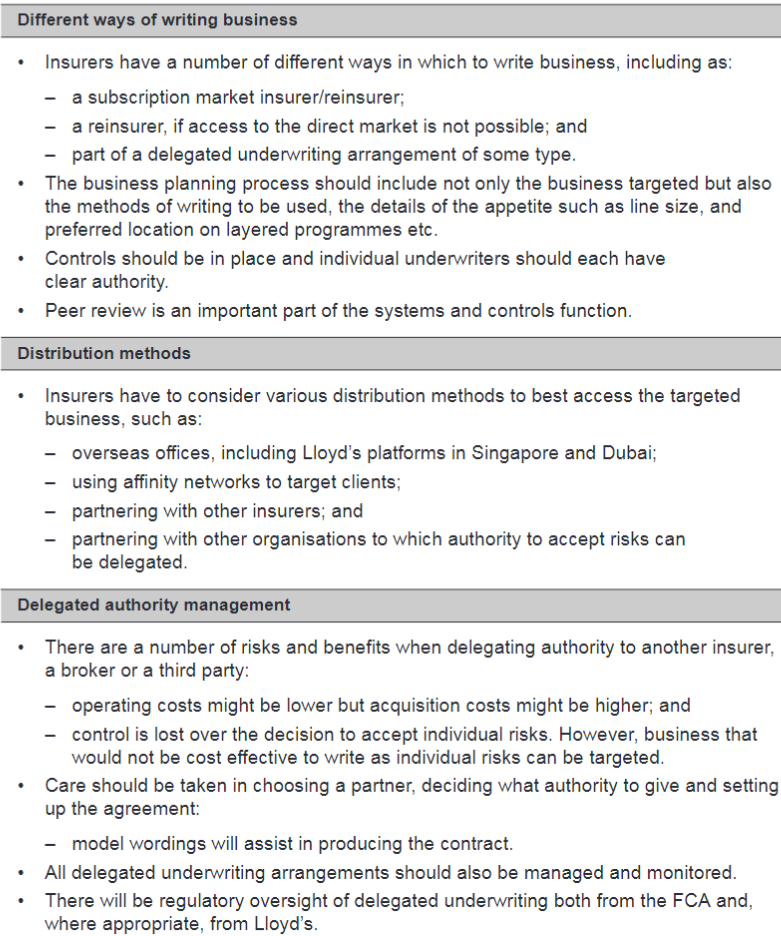
5.6.5 Extra
Contract Certainty
Document setting out agreement is CLEAR
- Extent of the authority
- Rights and obligations of both parties
Same principles apply for Lineslips and consortium
or
binding authority to 3rd party
Value of model wordings
Contracts for and of insurance
London Market has formatted templates for the
- Creation of Binding Authorities,
- lineslips and lineslip declarations
2023.04.28-MRC-Template-v3.0 1, page 1
OTHER templates include for the schedule to a binding authority only
LMA Clauses
Contracts between insurers, or between insurers and their coverholders, will form the basis of any audit or formal dispute resolution.
Lloyds coverholders contracts issued must contain:
- Wrapper cover: LMA3136J
- Schedule or declaration page: policyholder attention of main terms and variable info
- FULL product wording:
The schedule contains specific contract information and adds to the generic wording which contains gaps.
Poor contract draft impact on stakeholders
- Insurers:
- wider coverage then desired
- unclear termination = ON RISK longer
- reputational risk
- deal with claims
- penalties or regulatory issues
- Coverholders
- authority narrower
- reputational risk
- delegated Contracts cancelled
- Insured
- claims delayed due to query of coverage
- legal ramification for incorrect insurance