LM3 - C1 - Framework of Business
1.1 Frameworks within the London markets
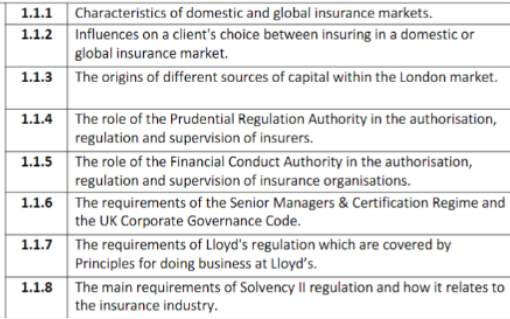
1.1.1 Domestic market and global market
- Serves customers in own territory
- Customers from other countries
London had remains largest globally for premium volume. 10% market share $160bn then US $80bn.
Lloyds customer base in the USA and Canada is higher than it is for the company market due to distribution network? Why the difference?
1.1.2 Clients choice between Domestic and Global markets only
Why clients choose a domestic market over a global market insurance
- Served well historically and loyalty
- Clients needs - Broker might not offer global market option
- Local market have set capacity to handle risk or not in appetite
- Domestic might be leader and global followers State/national insurers have stifled competition in certain markets EG LATAM
Underwriting platforms in CHINA
Looking to...
Singapore and Dubia: service companies (sister company to syndicate and managing agency)
Lloyds branches abroad
Licensing and regulation
- Companies obtain permission to accept risk (Lloyds central licensing)
- Blue print 2 Open market, delegated authority and claims.
1.1.3 Different Sources of capital within London Market
All organisations need capital to operate.
Insurers have an Insurance company and a Lloyd's Syndicate
- USA
- Bermuda
- UK
Ordinary membership - is open to all international and wholesale insurance and reinsurance which HOLD a LICENSE from own domestic regulator to transact business
Other types
- Private
- ‘worldwide non-insurance’ - Insurance-linked securities (transfer risk to capital market investors) VIA CAT BONDs
- Syndicate in a box -
1.1 UK regulation
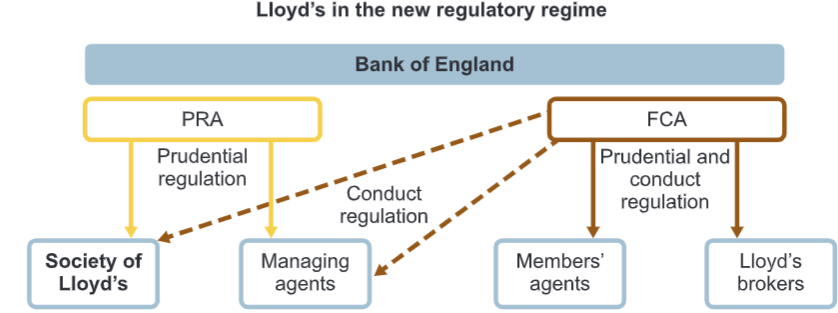
- FCA & PRA for insurers & Society of lloyds
- FCA for lloyds broker only
Insurance distribution directive
doing business in EU.
EU passporting: Authorisation in an insurer’s EU Home State generally permits business across the EU without additional local financial or solvency requirements.
An insurer can trade through a local branch (“establishment”)
or
Directly across borders from its Home State (“services”),
while complying with local policyholder-protection rules.
1.1.4 Role of PRA in authorisation regulation and supervision of insurances.
PRA Rulebook
- allocation of responsibilities;
- conduct standards;
- fitness and propriety;
- senior insurance management functions; and
- Lloyd’s – special provisions.
PRA insurance - allocate responsibility via SM&CR
PRA insurance - Fitness and Propriety (Person act with integrity, skill ext)
PRA insurers
- risk management, compliance, internal audit, actuarial, anything concerning the effective running of the firm, or anything else which is of specific importance to the sound and prudent management of the firm.
1.1.5 Role of FCA in authorisation regulation and supervision of insurance organisations
FCA PRIN (Principle for business)
High level principles in the FCA hand book applicable:
integrity, skill, risk management, financial resources, fair treatment EXT
FCA ICOBS ( Insurance conduct of business)
- Distance marketing products
- Advising clients clearly to inform purchasing decision
- Rights to cancel and effects of cancellation
- Handling claim
Alignment of the regulators’ expectations with the CII Code of Ethics & Vulnerable customers
FCA Consumer Duty
• Products and services. • Price and value. • Consumer understanding. • Consumer support
1.1.6 REQUIRMENTS of Senior Managers and Certification Regime (SM&CR) and UK corporate governance code
SM&CR applies to both insurers and brokers/intermediaries.
Senior Managers Regime - need FCA or PRA approval for each senior manager and a statement of responsibilities. (prescribed responsibilities)
Certification Regime
not senior managers but role mean for them to cause ‘significant harm’ to the firm or its customers
Conduct rules
- Individual conduct rules = integrity, cooperative with REGs, standards of market conduct
- Senior manager conduct rules = business complies with REGs standards, delegation of responsibilities
Reasonably expect notice is disclosed appropriately information
UK Corporate Governance Code
-
Board leadership and company purpose
Principle- Led by board to generate value, purpose values and strategy, REPORTING + Engagement of the board, workforces policies and practices are consistent
Provisions - Board minutes, If 20% of shareholders disagree board explains
- Led by board to generate value, purpose values and strategy, REPORTING + Engagement of the board, workforces policies and practices are consistent
-
Division of responsibilities
Principles
1. Chair leads board, Objective driven and promote openness
Provisions
2. Independence of role and personal, annual reporting 50% of board should be non executives -
Composition succession and evaluation
Principles
1. Board selection based on merit and objective criteria
Provisions
2. Succession planning, chair no longer than 9 years, PIP -
Audit, risk and internal control
Principles
1. Oversea interna; control framework, effectiveness of audits
Provisions
2. Succession planning, chair no longer than 9 years, PIP -
Remuneration
Principles
1. Directors compensation determined by board
Provisions
2. Remuneration committee and workforce review
1.1.7 Lloyd's REGs Byelaws
Byelaws
passed by Council of lloyd's
Underwriting Byelaws
- Permission to set up Managing Agent
- Relationship and Service Advise
- Business Plans and Performance disclosure with Lloyds
Intermediaries Byelaw
Principles of doing business at Lloyds
- Underwriting profitability
- Cat Exposure
- Outwards reinsurance
- Claims management
- Customer Outcomes
- Reserving
- Capital
- Investments
- Liquidity
- Governance, REGS oversight
maturity matrix - expected behaviour
Strategy
Foundations - lead/follow, open/delegated, line size deployment
Intermediate - sub-class, industry, geography, Distribution channel/placement strategy
Established - forward looking plan concerning key targets Won/Renewed
Advanced - Regular horizon scanning towards
1.1.8 Main requirements of Solvency 2 Regulations in insurance industry!
EU Reg Solvency II still used in UK
UK equivalent
Financial service and markets (FSMA) act 2023
Solvency 2
-
Own Risk and solvency Assessment - Identify, Assess, Monitor , Report Short/Long Tail Risk to ensure ORSA solvency all time
-
Calculation Kernel - Central method to Quantify/Modelling Risk and Capital Requirements in the Internal Model
-
Internal Model - Overall risk position, capital to meet risks used to calculate SCR
-
Minimum capital requirement - minimum level of capital before intervention (PRA)
-
Solvency Capital Requirement - Higher is prudent amount fed into Lloyds model
1.2 Duties of the Intermediary during contract creation

1.2.1 Role of different types of Intermediary Operating in London Market
- Single - offer customer product from single insurer
- Multi - different product from 1 insurer
- Independent - search market for best insurer for client
- Coverholder - Authority to insurer or client
- Managing General Agent - have been delegated authority by insurer or broker (DUAL by Howden)
- Open Market - Certain Regions (Canada, Israel, Italy, Nambia, Portugal, South Africa, Spain and Switzerland)
Client money in trust accounts 2 types
- Non statutory - Hold commercial and consumer with controls to manage it
- Statutory - Default trusts for intermediaries unable to meet the reequipments of a non statutory trust
Risk transfer
IF broker becomes insolvent The customer may then be left without cover if the premium did not reach the insurer
This means that an insurer treats premiums received by an intermediary, which sells its insurance, as having been received by itself and has a contract to support this arrangement. TOBA
Wholesale vs retail
Retail = closest to the insured; producing = originates the business.
Retail broker faces the buyer of the insurance product BUT uses another Wholesale broker to access the insurers in London market
Consumer - policy in own language and "cooling off" period
Commercial - Very large values. also reinsurance business traded.
Broker obtain risk for insurers and they chose panel + leaders
1.2.2 Regulatory of Insurance Intermediaries
Brokers and Coverholder regulated by FCA for prudential and conduct matter
IDD - Insurance distribution directive
SETS consumer protection provisions in insurance + regulation
- Professionalism
- Commission disclosure of remuneration
- New product governance requirements -
- Ancillary insurance intermediaries - In the name think Ryan air selling travel insurance
- Insurance product information documents - Summary document to compare products
must be clear, fair and not misleading.
1.2.3 Role of Intermediaries in Underwriting process
A broker introducing business to an insurer is a key part of obtaining risks and of an insurer’s overall distribution network.
It is as important for an insurer to know and be known by the brokers in their class of business as by any ultimate insured clients.
Brokers will often play a large part in the selection of the leaders as well as the rest of the insurers.
Intermediaries play a large part in the planning, underwriting, pricing and documentation of risks written in the London Market
Key points