LM3 - C3 - Business Planning (Original)
LO - B, C, A, D
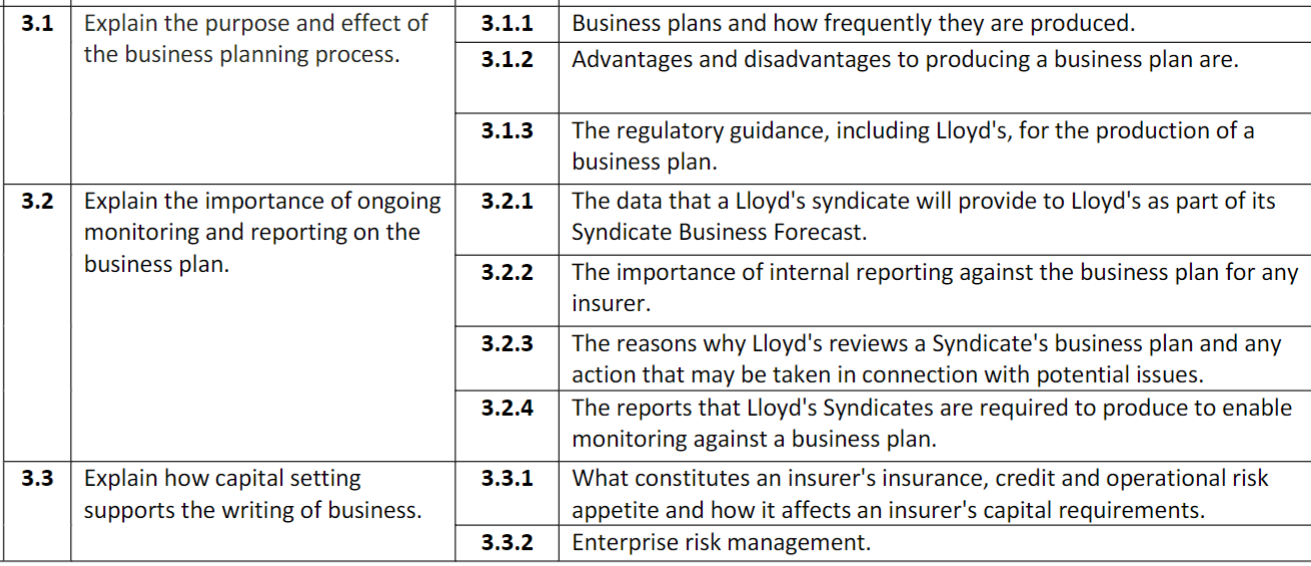
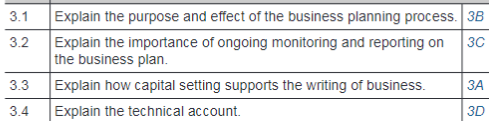
3.1 Purpose and effect of Business planning process?
3.1.1 Business Plans and How Frequently They Are Produced
Organic documents which can change throughout the year, covers next underwriting year.
Insurers normally produce a formal business plan annually, covering the next underwriting year.
- The plan sets out matters such as:
- target classes and territories;
- expected premium and loss ratios;
- distribution methods;
- underwriting controls;
- expenses and acquisition costs;
- reinsurance strategy; and
- capital requirements.
A Lloyd's syndicate submits its annual plan through the Syndicate Business Forecast.
- Planning discussions with Lloyd's usually begin around June.
- The final forecast submission early September and approved by the end of November, before the new year of account begins.
- Syndicates also discuss their one-year and three-year plans with Lloyd's.
Although formally produced annually, the plan is a living document:
- performance is monitored throughout the year; and
- proposed changes should be justified and approved before implementation.
3.1.2 Pros and Cons of Business Plan
Advantages:
- Clarity for key stakeholders business - board, management and staff all understand direction
- Investors for capital/equity planning - ROCE and profit expectations
- REGs concerns of organisation structure - demonstrates to FCA, PRA, Lloyds organisations have structures, risk management and strategic intent
Disadvantages: - Spontaneity not being allowed,
- Performance not accordance with plan
- Resource and time costs
3.1.3 REGs Guidance from Lloyds for Production of Plan
UK: FCA & PRA require a business plan under SYSC
Reverse stress test its business plan + scenario analyses Lloyds
- identify range of adverse circumstances cause business plan to unviable and likelihood
- If found prevent or mitigate risk
External plan reviewed by Lloyds
Syndicate plan is reviewed by Lloyds Syndicate "Business Performance Team" and "Capital and Planning Group" - feedback given to syndicates.
Logical, Realistic, Achievable
- Syndicate expands by poaching teams
- Multiple syndicates target a class
- Multiple syndicates target a single reinsurer
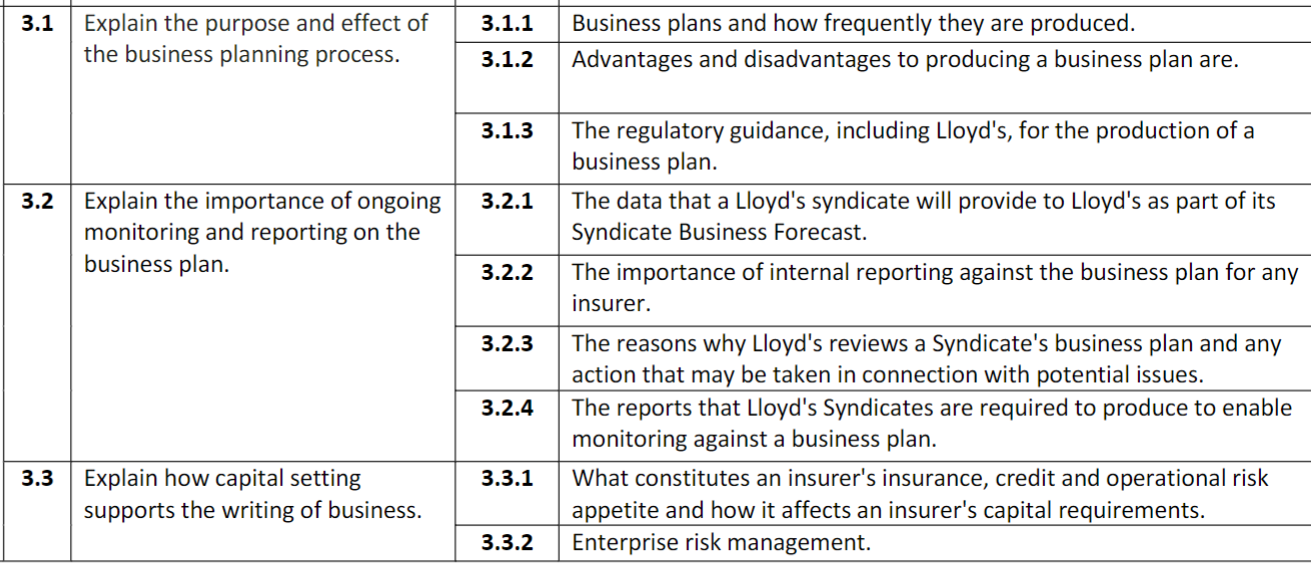
3.2 Ongoing Monitoring and Reporting on the Business plan (Map)
What is your desired destination? Routes to take? Roadblock management!
3.2.1 Syndicate reporting to Lloyds and what get fed back
Lloyds syndicate business planning process
Plan is challenged and approved by board. Syndicate business forecast
Lloyds organises meetings with syndicates HAVE oversight on their business plan
Oversight categories (3 tiers):
- Light touch — syndicates with strong track record, lower monitoring intensity
- Standard — typical oversight level
- High touch — greatest oversight; syndicates with higher risk or weaker track record
Exchange rates - Set by Lloyd's
COB description - Risk Code per COB
Risk code mapping - (Risk code based max line size)
underwriting performance forecast - income, liability forecast
premium income by risk code -
loss ratio composition - att, large, Cat. write more cat?
type of placement - direct, reinsurance, lineslip, delegated authority.
premium income by risk code
premium bridging analysis - WHY LESS PREMIUM YOY? Are deduction expected to be higher?
Capacity information - Backers? aligned or non aligned?
Underwriting controls - Everyone has authority recorded
RDS - Impacts on business due to certain Loss CAT or Man-made
Outwards reinsurance premium - How much spent? types? Identity of reinsurers.
3.2.2 Importance of Internal reporting - Monitored Internally CONTINUOUSLY
What does into the PLAN:
- COB - classes of business
- GWP - gross written premium (Anticipated)
- Planned Loss Ratio
- Premium Distribution
- Geographical spread
- Acquisition costs
- Operational costs
- Sources of business
- Reinsurance strategy
Prevent wrong turns!!!
Against Business Plan:
- Are Targets and control achieved?
- Will GWP targets be met?
Senior Management Arrangements, Systems and Controls 4.1: STAY ON TOP!
Are targets and controls being achieved? Will GWP targets be met?
3.2.3 Why Monitor/report on the plan?
Issues spotted
- Refer to satisfying risk appetite
- Regulation change in a Market: Insurers have to be AGILE to market events quicker and profit
Changing the plan
- NOT always negative... 6 months in a YOA market shifts
- Change with a Reason Why! present to Management and board and Lloyd's if required.
Monitoring capital requirements
- Capital is required to run the business (Determined by Board)... Balance RISK on the business (insurance, operational, credit...)
- Capital requirements to deliver PLAN.
Lloyd's syndicates have to file a Lloyd's capital return to provide the syndicate-level data required to calculate the overall Lloyd's-level solvency capital requirement
Solvency 2 - Minimum Capital Requirement is set below which policyholder would be exposed to an unacceptable level of risk require intervention. protection from a 1 in 200 year event.
If there is inadequate regulatory capital what impact will this have on the business? It will need to:
- raise more regulatory capital by issuing shares or issuing long-term debt that satisfies the PRA requirements
- reduce the business written,
- classes which have high capital requirements, or
- buy more reinsurance (of a good quality).
Wording used in claims data
Data cleaning tool/organising tool! select a column and then process/save to right locations
3.2.4 Reports Lloyd's Syndicates Must Produce to Enable Monitoring
External reporting to Lloyd's:
-
Performance Management Data - Monthly, GWP, TP, RARC (Think Monday Meeting!)
-
- Gross Quarterly Data (Signed Premium + paid/outstanding claims) - monitor IBNR (set aside for unexpected deterioration), reserves.
-
Monitoring COB performance Quarterly - UGGWP, Acq, GLR why? Analysis plan against PLAN
-
Reinsurance programme Quarterly - How Robust is Reinsurers! Lloyds
-
RDS Annually - Large Loss net and gross of reinsurance
SYSC - Senior Management Arrangements systems and controls LM2 - C2 - Risk Written in London Market
- MiFID = Markets in Financial Instruments Directive.
- UCITS = Undertakings for Collective Investment of Transferable Securities
Lloyd's Principles - Data capture and reporting
1 - Underwriting profitability
10 - Governance risk management and reporting
12 - Operational Resilience
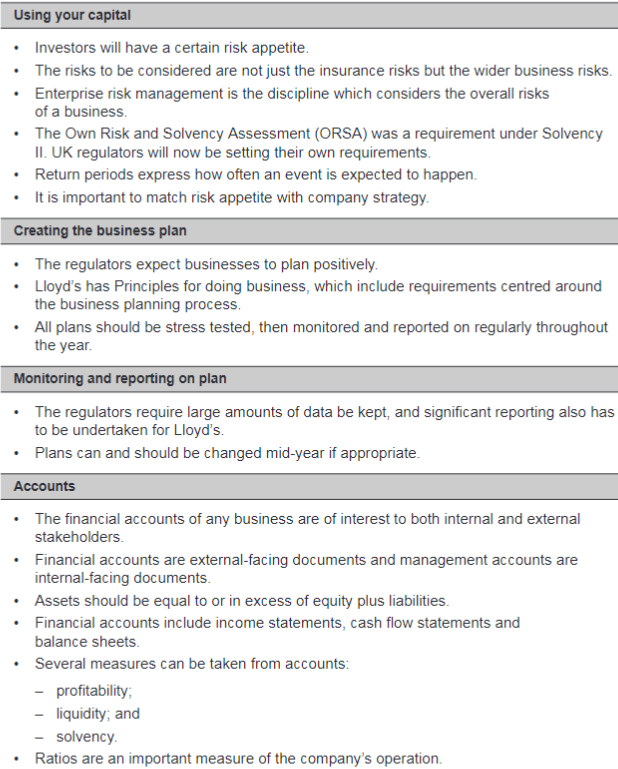
3.3 Capital Settings Supports Writing of business
Matching Risk Appetite with Company Strategy
Risk appetite is the level and type of risk an insurer is willing to accept to achieve strategic objectives.
- Risk type, and which are not excepted!
- Probability of failure - deemed to be acceptable (EG 1 in 100 over 1 year)
- Max loss from any one incident? (Premium rate comes from these factors)
COMPONENTS of RISK APPETITE
Insurance Risk
- Target Areas of business
- Areas of business not being written
- New market targets
- Distribution models
Examples:- Total claims that exceed 65% of premium
- No appetite from business from Latin America to exceed 20% of Premium income
- Claims reserves to more than 2%...
Credit/Counterparty
- A tolerance of counterparty losses of up to 5% of reinsurance recoverable.
- Measured against reinsurer rating, concentration, financial strength
probability of failure deemed to be acceptable...
PRA failure no higher than 1 in 200 year event
Return periods
Likelihood of failure is a 1 in 200 year event over a 12 month period. MEASURE of likelihood of recurrence of a particular event.
models are not always right about frequency and severity
Own Risk and solvency assessment (ORSA)
Lloyds Principles
7 - Capital
10 - Governance, risk management and reporting
1. Foundation level: Managing agents own assessment of the RISKS
2. Advanced level: Risk management framework
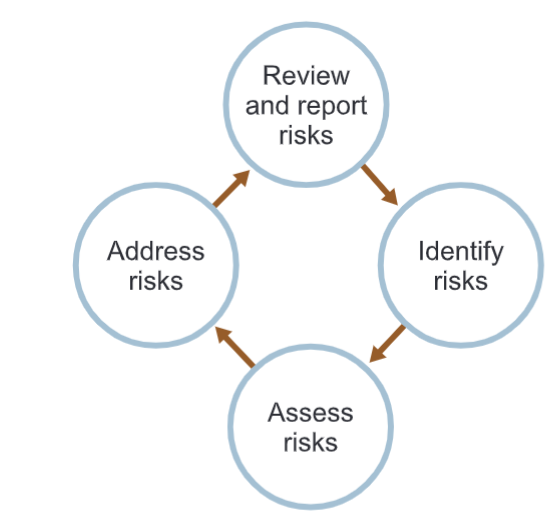
Enterprise Risk Management
ERM - assess frequency and severity + mitigation + monitoring
Review/report risks, ID risks, Assess risk, Address risk
Risk register
Imagine the black swans
Unpredictability, financial impact, shock effects
WTC 2001 or COVID 19
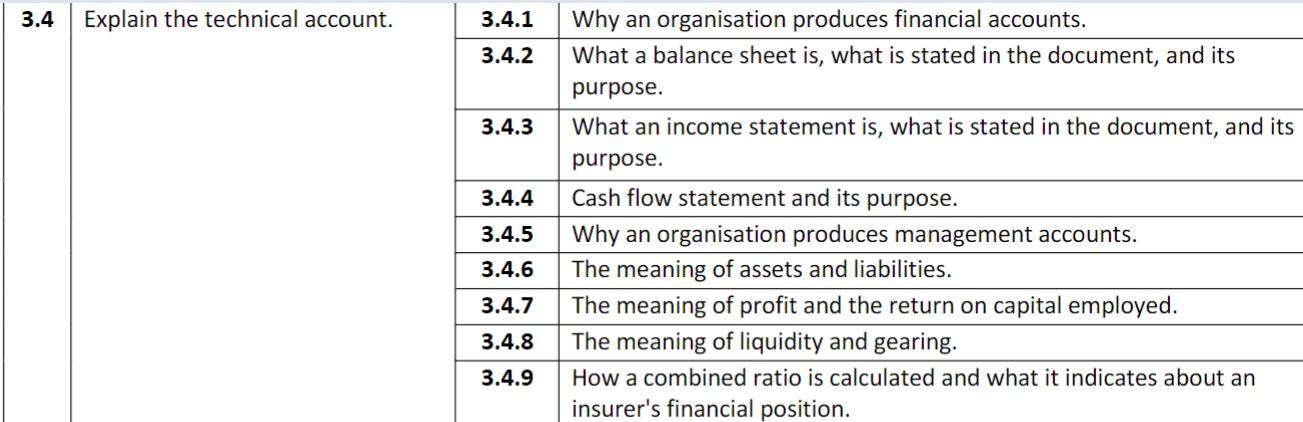
3.4 Accounts
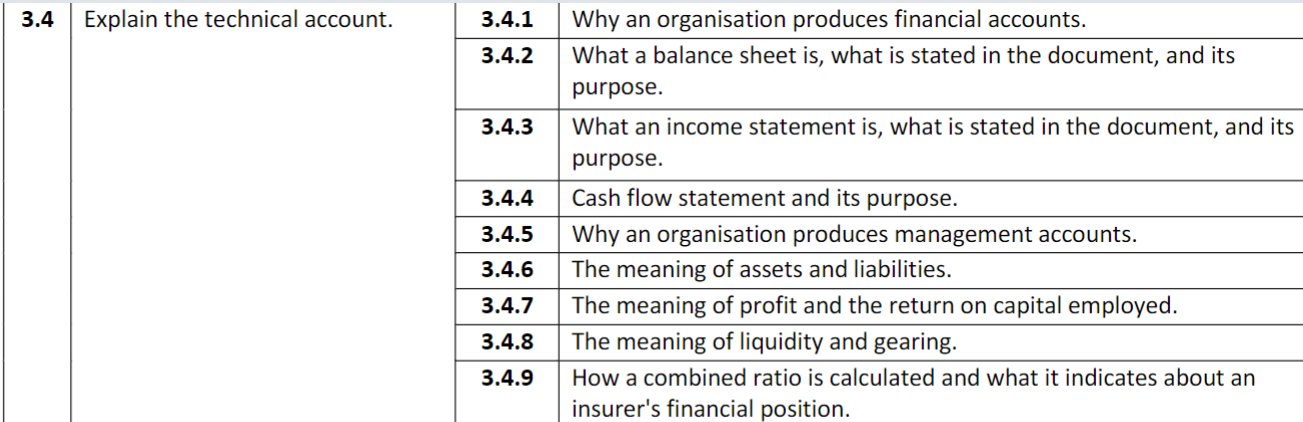
3.4.1/5 Why an Organisation produces financial accounts and Management Accounts
Define minimum positive return on their capital
Financial Accounts Current position (comparable with other organisations)
- Stewardship — Board and management report to shareholders/owners on capital entrusted to them
- Comparability — Stakeholders (regulators, investors, rating agencies) can compare performance across insurers
- Transparency — External parties (regulators, creditors, clients) assess financial health
- Profitability assessment — Over a 3-year cycle (RITC — Return on Technical Capital after 36 months), assess whether the insurer is profitable and meeting capital return targets
GAAP - annual accounting cycle produce Income statements and balance sheet.
Management accounts - Used for forward planning (Internal purpose)
- strategic planning process - when looking at an insurer's business planning
- Reporting - bi/weekly, monthly
- Where is the profit centre in a business, Variance and indications
3.4.2/6 Balance sheet - Organisations Year End
Assets (Tangible/Intangible) - Liabilities (Claims)!
Tangible - Physical (Cash or Buildings)
or
Intangible - Goodwill/Copyright
Insurers main liability is Claims Presents and Paid. Equation:
Assets = Liabilities + Equity
A snapshot of assets and liabilities at a specific point in time (year-end or accounting period).
Provisions for unearned premium:
- Assets - ONLY previous year rolling forward!
- Liability - YTD premium not earned.
Provisions for losses and adjustments expenses: - Liability side Ultimate cost of all claims incurred + IBNR.
Reinsurance: - Asset Recoveries
- Cost on liability side
Investments: Asset side
Debtors: Premium written invoiced but not yet paid by broker
3.4.3 Income statement - Profit/loss Account + Yearly
Income^d4bbb4
- Premium income = GWP
- Outwards RI Premium
- Premium Provision on Gross Basis! Come forward as unearned from last year and unearned this year. Reinsurance share of premium provision
- Earned throughout policy period
- Net earned premium & Net Investment Returns
Expenses
- Claims ULR
- Acquisition costs
- Opex
- Reinsurance
- Reinsurance recovery
- Tax
Negative amount deducted from the GWP, and the reinsurance claims are added back in to reduce the Liabilities shown by the claims in the expenses area.
3.4.4 Cash Flow - Statement of retained earnings (Redirected within organisations)
Cash flow - good when:
- Premium Income based on Written Premiums + On Time Payment. Influence:
- Operating (Claims),
- Investment,
- Financing
Liquidity - How quickly assets convert to cash? A position of having adequate cash available.
Solvency - Amount?
3.4.7/8 Key Terminology - Profit, ROCE, Liquidity and Gearing (Equations)
Profit and ROCE (Productivity)
Profit is the outcome of an Income Sheet
- Profitability on revenue (large (40%) vs small (2%))?
- What return will be obtained on capital (At least 2x bank return uncorrelated?)
- Speculation on how much claims cost, expenses and claims reserve
Productivity - Insurance is in the business of producing contracts
- Solvency 2 - Risk of counterparty/credit risk (Risk of bad debt relating to premium)
Liquidity (assets to cash) & Gearing (Leverage)
More liquid the assets better to pay creditors on time (Convert to Cash)
(Excl stock. Need an overdraft? from bank)
liquidity Ratio = Total Liabilities divided by its cash plus investments
Activity looks at number of policy written and policy paid ratio
How much the business borrowing compared to investors equity in the business?
Gearing: Measure of how reliant on debt finance
Regulators only like to certain debt which doesn't appear as liability on the balance sheet. Debt and interest always gets serviced
- Raise money to expand the business and make enough additional profit to service debt
3.4.9 Combined Ratio and Financial Position
Net premium / losses + expenses + commissions
Total incurred Losses + expenses / earned premium
how effectively a class of business is performing, while competitors reviewing their operation against that of their counterparts
Senior management - Allocation to area of business next year
Metrics (Stakeholders assess)
- Profitability - Money left from all costs/expenses from income
- liquidity - Cash on hand or assets
- Income/revenue/turnover - insurance premium volume
- Expenditure (Op/Cap)
- Organisational wealth - how much assets business have
- Working capital - Difference between Assets and liabilities Shorter time horizon then Equity (claims paid and outstanding)
- Solvency - More Assets then liabilities
Capital
LM3 - C3 - Business Planning - (Debt is not always liability check PRA definitions)
Capital must be accepted by regulators.
Solvency - Assets against liabilities
Key Points